What is Tandm?
On this blog
What is Tandm?
Tandm is a voice-first platform for industrial frontline workers. A worker speaks, in their own language, to report a hazard, raise or update a maintenance request, run an inspection, or ask a question.
Tandm understands what they said, turns it into structured data, works out what needs to happen next, and routes it to the right person and the system you already run, whether that's IBM Maximo, SAP, Intelex, or Cority.
Here's the shift underneath it. Most industrial software is a system of record: it files what got logged and waits for someone to read it.
Tandm is a system of intelligence. It captures what's actually happening on the floor, decides what to do about it, and remembers it, so the operation gets a little smarter every shift.
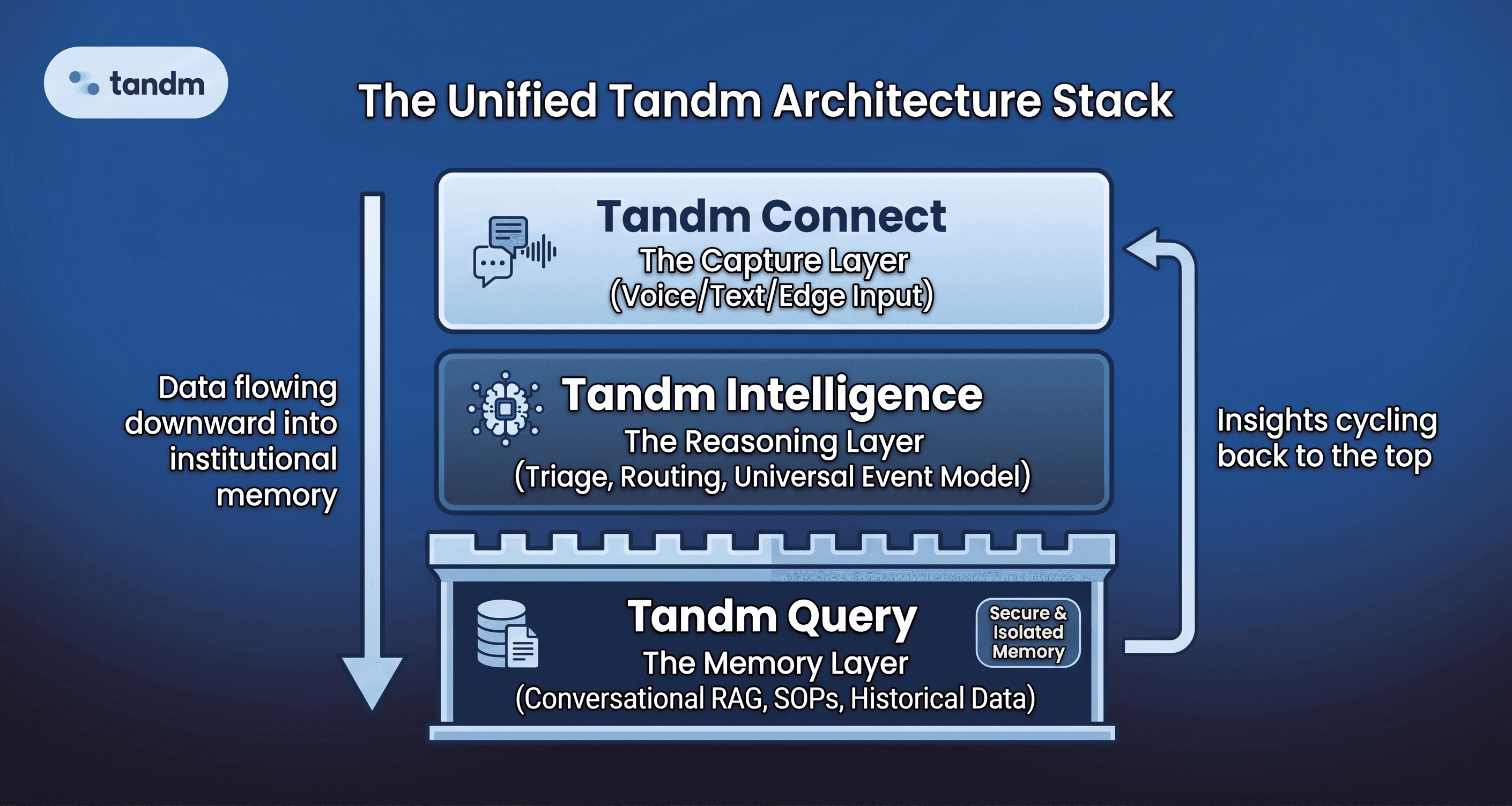
The product is three layers that run as one system. Tandm Connect captures what's happening. Intelligence makes it actionable. Tandm Query makes it permanent.
Why Tandm matters to frontline workers?
For twenty-five years, industrial software has been filing records while the real operation runs somewhere else. Companies have spent heavily on systems for safety, maintenance, and operations, and those systems do one job well.
They produce records for auditors and managers. They were built for someone at a desk, not for a worker in gloves at a conveyor in the cold.
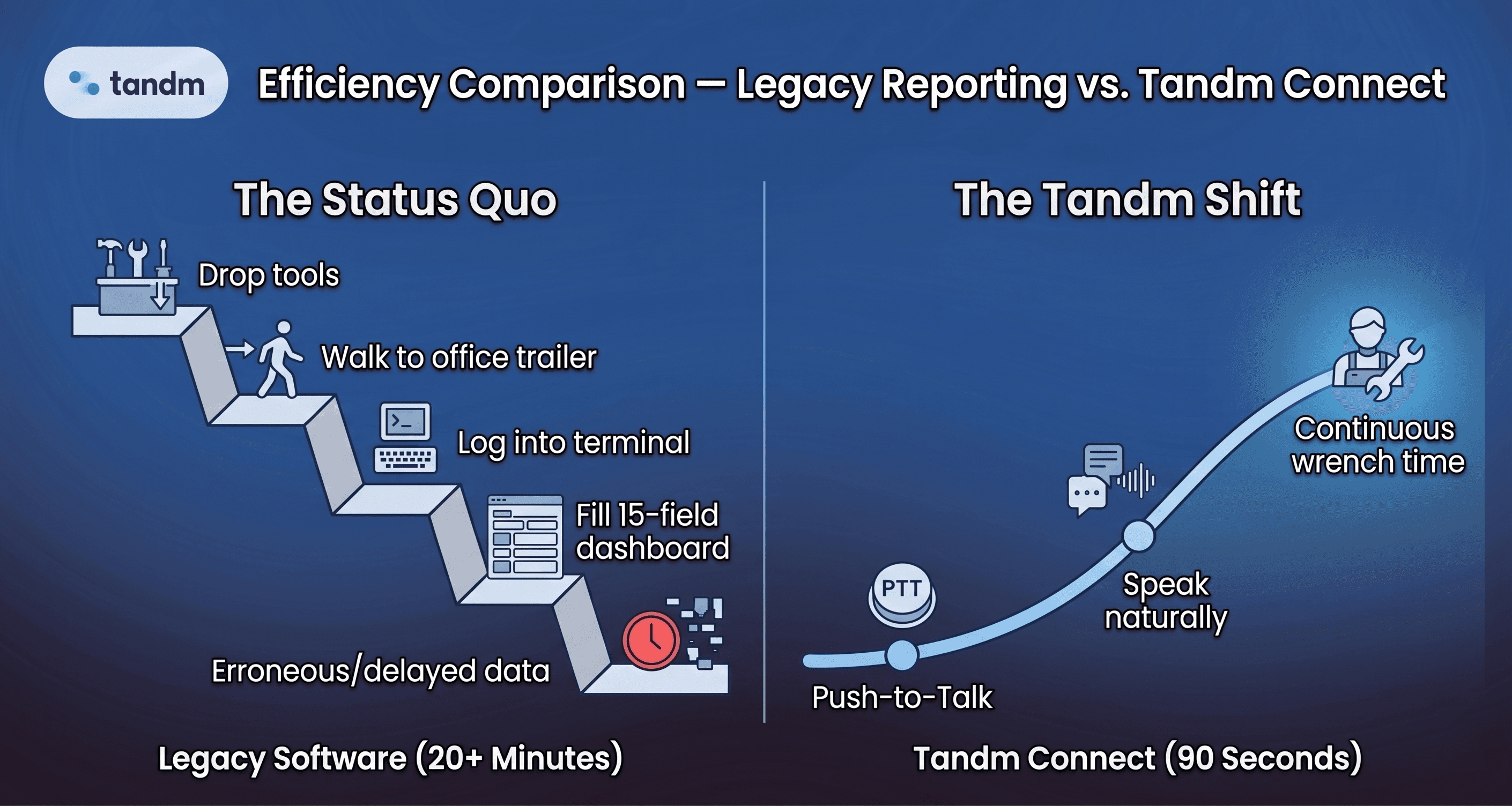
So a gap opens up. If a worker has to drop their tools, walk to an office trailer, log into a fifteen-field dashboard, and type out what happened, one of two things follows.
They skip it, or they scribble a note on a scrap of cardboard at the end of a twelve-hour shift. Either way, most of what actually happens on the floor never makes it into any system.
That gap between what happens and the thin slice the software ever sees is the Capture Gap, and it's why so many operations make decisions on a fraction of the real signal.
There's a second cost on top of it. Every report asks a worker to translate what just happened into a rigid form, often in a second language.
That's the translation tax, and it's the quiet reason the frontline opts out.
And the most experienced people carry the knowledge that matters most: which pump fails how, which warning signs come before a breakdown, which fix is actually held.
Almost none of it gets written down, and it drains out of the operation every day, through retirement, turnover, contractor churn, and the radio fix nobody logged.
That steady drain is the Knowledge Leak. Left unchecked, it leaves you with Operational Amnesia: an operation that can't remember what it already knows, so it relearns the same failures year after year.
Tandm starts by closing the Capture Gap, because if the data never gets in, nothing else is possible.
Tandm Connect: capture the frontline will actually use
Connect is the worker-facing layer, built for the places legacy software never was: loud, dirty, mobile, time-pressured, and often at the edge of a signal.
Workers can use voice, text, a form, or a checklist, and voice is treated as a first-class input, not a novelty.
How Tandm Connect works in the field
The technician just talks. Tandm Connect captures the audio, pulls out the fields that matter (asset ID, location, severity, what's wrong), checks back on anything it's unsure of, and writes a clean record into the system you already run.
No menus, no typing, no walk back to the trailer. Capture takes about 90 seconds of talking instead of a fifteen-field desktop form.
A real example from site
A technician on a routine walkaround spots a crack forming near the discharge chute of a primary conveyor. He holds the button on his radio and says:
"Tandm, log a critical maintenance request. The structural support frame on Conveyor Chute 4 in Zone 2 has a six-inch hairline fracture. Needs welding before the next shift run."
Tandm Connect captures the audio, reads back the location (Zone 2, Conveyor Chute 4), flags the severity as high, categorizes the work as structural welding, and builds the work order in IBM Maximo. Under 90 seconds, gloves on the whole time.
What Tandm Connect does for the worker
No paperwork backlog. No more spending the last forty-five minutes of a shift filling out forms from memory.
Hands and eyes stay on the work. Gloves stay on, tools stay ready, attention stays on the machine, which lowers line-of-fire risk.
A reply, not a black hole. Connect confirms out loud that the report was captured and routed, so the worker knows it landed.
What Tandm Connect does for the operation
Wrench time goes back to wrenching. Crews spend their time fixing equipment, not typing in an office trailer.
Cleaner data, captured live. You get ground-truth detail the moment an issue is found, not a fuzzy recollection logged hours later.
Small problems caught early. Catching an early-stage crack before it becomes a structural failure protects uptime and keeps a cheap fix from becoming an emergency repair.
Tandm Intelligence: the layer that decides what to do
Capturing a report is only useful if something happens next. In most operations, that next step is manual.
A report lands in a queue, a coordinator eventually reads it, decides what to do, assigns it, and sometimes follows up.
This is the layer the category has never really had. It's the reasoning layer: the part that decides what to do after capture.
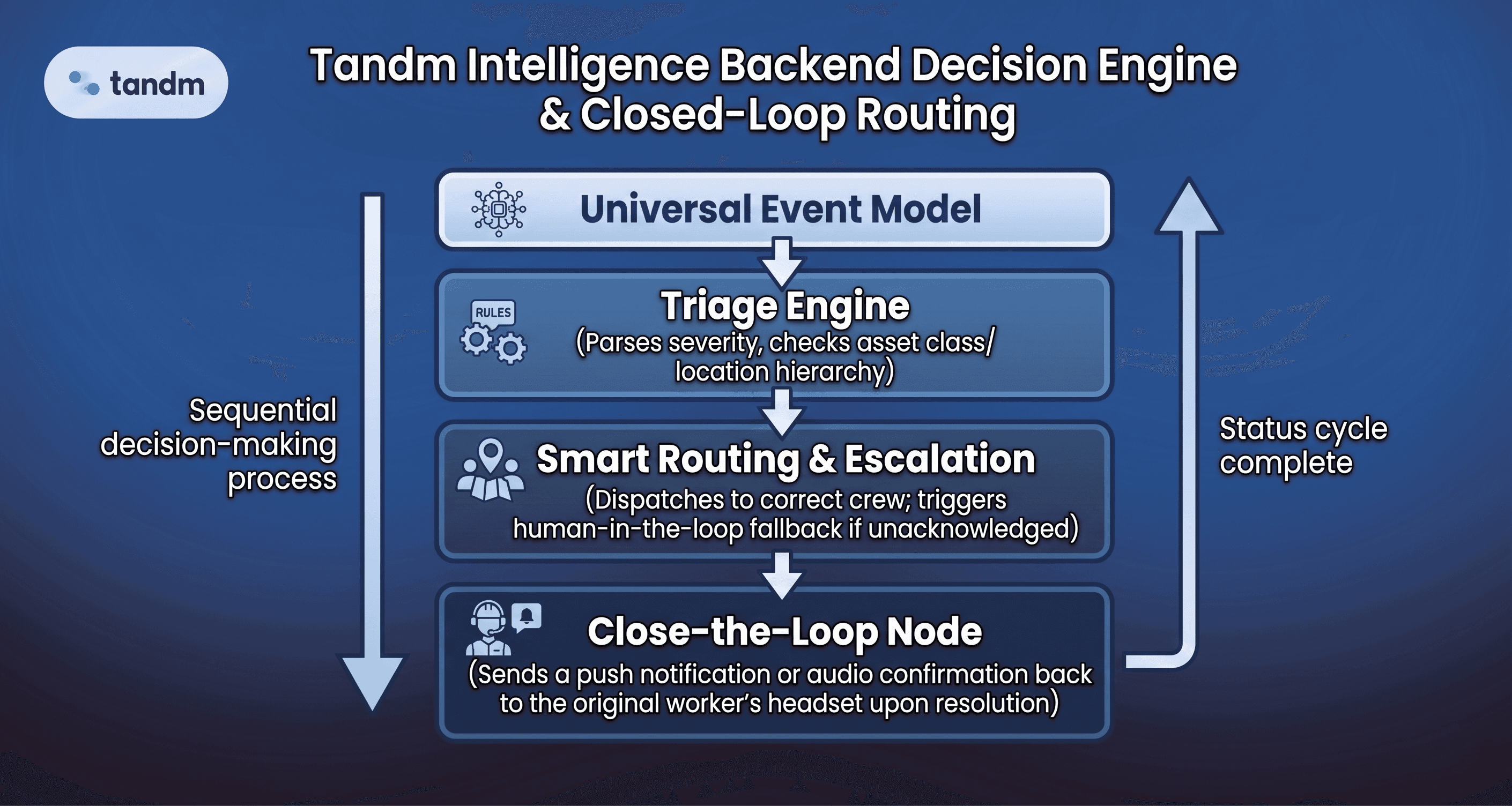
Here's what Tandm Intelligence does with every event Tandm Connect captures.
It lands in one model. Every event, whether it's a hazard report, a maintenance request, an inspection result, or a quality issue, goes into a single universal event model, structured the same way and scoped to the same location hierarchy (facility, zone, area, asset). One place, one shape, ready to act on.
It gets read and triaged. Intelligence reads each event, judges its severity, and works out where it needs to go. The conveyor crack above isn't just stored. It's recognized as a high-severity structural issue on a specific asset.
It gets routed and turned into action. Intelligence sends it to the right person, team, or shift, and creates an action with a clear owner and a defined way to close it. For high-stakes calls, a human stays in the loop to review before anything executes. If the action isn't acknowledged in time, it escalates.
It closes the loop. When the action is done, the worker who raised it gets told. This is the part that makes the whole system work. People report when they can see that reporting leads to something. When the floor learns that a report disappears into a void, reporting dies, and so does the data. Closing the loop is how Tandm earns the next report, and the one after that.
Every closed event also stays. Over months, Tandm Intelligence builds a structured record of what has actually happened in your facility, on your equipment, with your crew.
That record is something a system of record can't produce, and it's the foundation for the third layer.
Tandm Query: institutional memory on demand
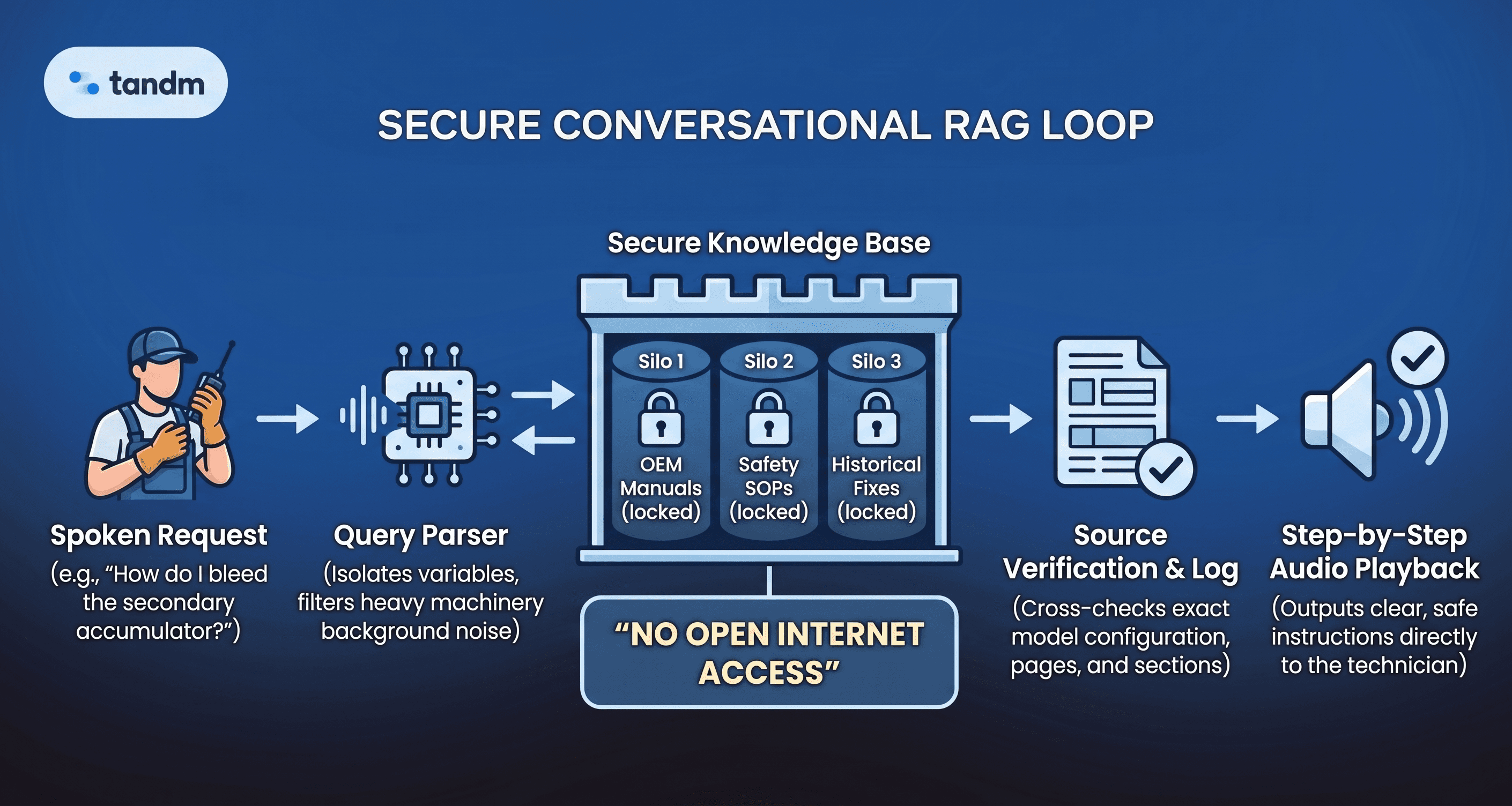
Query is the memory layer. It gives workers and managers conversational access to two things: your formal documentation (SOPs, OEM manuals, lockout/tagout procedures) and the operational history Intelligence has been building.
It runs on a retrieval-augmented setup that pulls answers from your own verified knowledge bases, not the open internet.
The result is Operational Memory: the living, searchable record of what your operation knows, so it stops relearning the same failures.
On day one, it looks like "what's the lockout procedure for this press?" As the history builds, it looks like "which corrective action actually held for this fault?" or "where have we had the most near-misses on this asset class in the last 90 days?"
How Tandm Query works in the field
Instead of flipping through a greasy 400-page binder or digging through a SharePoint folder on a phone, the worker asks out loud and Tandm Query reads the exact steps back into their earpiece.
A real example from site
A haulage technician is standing next to a CAT 797F that locked its brakes and threw a hydraulic fault code, halting the haul route.
Step 1. The spoken question. Instead of walking back to a service truck and searching an OEM directory, he holds the push-to-talk on his radio and says:
"Tandm, I've got a CAT 797F throwing hydraulic pressure code 242-F in the active pit. How do I bleed the secondary steering accumulator to safely clear the fault?"
Step 2. Query understands the request. It takes the audio off the radio network, filters out the steady rumble of the pit, and identifies the key variables: a CAT 797F, in the active pit, the secondary steering hydraulic accumulator, fault code 242-F.
Step 3. It searches your knowledge bases, not the internet. Query reads the official CAT 797F field manual, your safety team's high-pressure fluid SOPs, and the lockout/tagout protocol for that fleet.
Step 4. It checks its source. Query matches the steps to the exact model year and configuration, and logs the source file, section, and page so there's an auditable record. It answers from your verified documents, which is what keeps it from inventing a procedure the way an open consumer model might.
Step 5. It reads back the steps. Within seconds, the technician hears clear, step-by-step instructions, gloves still on:
"Understood. For a CAT 797F with Hydraulic Pressure Fault 242-F, follow Section 4 of the OEM manual, page 118. One, confirm the parking brake is engaged and set the wheel chocks. Two, locate the secondary steering bleed valve behind the front left wheel arch. Three, slowly turn the pressure release valve counter-clockwise two full turns until the gauge reads zero PSI. Do not disconnect any hydraulic line until the dashboard warning light is fully off."
What Tandm Query does for the worker
Answers on demand. No twenty-minute walk to find a supervisor or a lost PDF.
Steps you can trust. Every answer comes with its source reference, so the worker is following the current standard.
Hands-free. Listen to torque specs or a calibration sequence while your hands stay on the tools.
What Tandm Query does for the operation
Fewer human errors. Standardizing procedures across shifts means fewer skipped steps and fewer stripped components.
Faster repairs. Arming a technician with the exact parameters at the machine cuts mean time to repair (MTTR).
Knowledge that stays. As senior people talk through how they solved an unusual problem, Query keeps those case histories, turning one person's experience into Operational Memory the whole site can reach.
How does Tandm work reliably in very loud, high-decibel environments?
Between jaw crushers, haul-truck engines, vibrating screens, and ventilation fans, background noise on an industrial site routinely runs 90 to 100 decibels.
Voice assistants built for quiet offices and consumer phones aren't designed for that.
Tandm uses acoustic models built to isolate human speech while filtering out the steady, repetitive signatures of heavy machinery.
It also works with the noise-canceling hardware your teams already wear, like industrial headsets and digital two-way radios with built-in mic arrays.
Together, hardware cancellation and speech filtering let it pick up commands even next to a running conveyor drive or diesel generator.
To keep bad data out, Tandm reads the key fields back before submitting:
"Understood. Logging a hydraulic leak on Front-End Loader 12. Press PTT or say 'Confirm' to submit."
That quick check means a misheard field gets caught before it ever reaches your backend systems.
What happens when workers lose signal?
Anything that needs a constant cloud connection will stall in the field.
Tandm is edge-capable, with an offline queue running locally on the device.
When a technician drops into an underground shaft or a remote dead zone, the platform keeps working.
They can complete a full inspection or document a safety risk by voice. Tandm Connect processes the input locally, structures the fields, and saves the record to encrypted storage on the device.
The moment they're back in range, pass an access point, or return to the surface, Tandm syncs the queued data to your enterprise system on its own.
No manual sync button, no lost reports, no blind spots in your visibility.
Why will frontline workers use it?
We know the history. The industrial sector is full of abandoned software.
Frontline crews are right to be wary of another app handed down from a corporate office, and they often read a new tool as a way for management to track their movements and police their time. That suspicion kills adoption before it starts.
Tandm earns its place because it's built for the people doing the work. The old systems were built for the auditor.
A few things make the difference:
It uses the gear they already carry. No extra device, no charging cables, no pulling off gloves to tap a phone screen in the mud. It runs through the radio and headset already on their vest.
It meets them in their own language. Industrial crews are diverse. A worker speaks in their native language at the point of work, and Tandm handles the structuring on the back end. The worker never has to translate themselves into a form, which is the translation tax most tools quietly charge.
It closes the loop. In a traditional setup, a worker files a hazard form and rarely hears a thing. Tandm pushes a reply to their headset when an action is taken or a job is resolved. When people see that their voice led to a safer, smoother site, adoption takes care of itself.
Does Tandm need a rip-and-replace?
No. Tandm follows an "integrate first, replace later" approach, so it starts as a low-risk addition, not a system overhaul.
It doesn't modify your core databases, rewrite your compliance processes, or touch your historical records.
It connects to your existing systems through secure APIs and quietly populates them with complete, real-time data from the field.
You can roll Tandm Connect out for a single job (shift-handover notes, or near-miss capture, say) in a couple of weeks, while your systems of record keep running exactly as they do today.
What earns the bigger conversation later is the data. Every event flows into Tandm Intelligence and builds an operational record your legacy system was never able to capture.
Within months you can see things you couldn't before: response times, closure rates, where incidents cluster, an asset's full event history.
By the time replacing the old system is on the table, Tandm already holds your data, your workflows, and your workers, so the move is low-risk by then.
How does Tandm work with existing two-way radios?
Workers don't want to juggle devices. Unclipping a phone, unlocking it, opening an app, and waiting for a connection just to log a small leak adds friction to every report.
Tandm connects into the communication gear you already run, whether that's digital two-way radios (Motorola MOTOTRBO or DMR systems), mesh intercoms, or enterprise push-to-talk apps.
Your team keeps the exact hardware they've used for years. To log a hazard or pull up an SOP, a worker switches to a set channel or holds a button on the headset, which opens a direct link to Tandm.
They speak, confirm, and let go. Tandm captures the transmission, processes it, and updates your backend systems.
Because it lives inside the radio workflow the crew already knows, the barrier to capturing data on the floor mostly disappears.
What are the deployment and hosting options?
Tandm is built for the security and compliance requirements of heavy-industrial and global mining enterprises.
Every deployment runs in a secure cloud environment that Tandm manages, so your IT team doesn't have to run servers, push updates, or maintain the software.
There are two hosting models.
Multi-tenant
A cost-effective, fast path to launch. Your instance runs in a shared AWS environment with record-level encryption, where each customer's data is isolated under its own cryptographic key. It uses a simple credit model tied to how many minutes your team uses the platform.
Single-tenant
Built for large enterprises that need maximum isolation and custom compliance. Your data, voice processing, and models run on dedicated, isolated infrastructure.
This option also gives you the flexibility to choose specific large language models per application, or bring your own pre-trained models into the platform.
Either way, every Tandm account comes with two workspaces: a Development (Dev) environment for safely testing new voice applications, and a live Production (Prod) environment for daily field operations.
Is Tandm secure?
Yes. Heavy-industrial and mining enterprises expect strong security before any new layer touches their stack, and Tandm is built for that bar.
Independently certified. Tandm is SOC 2 and ISO 27001 certified, so your data is handled under recognized security and operational standards.
Isolated and encrypted. The platform uses record-level encryption. Each customer's voice streams, parsed data, and operational history are isolated under unique cryptographic keys.
Answers from your data, not the internet. Query works only from your verified, closed knowledge bases, which is what keeps workers getting checked, sourced parameters instead of an open model's guesswork.
For a full breakdown of the network architecture and data-privacy controls, read the security assessment at Tandm Security & Safety.
Think Tandm could help? Reach out to us.
Nikhil Riley (Tandm CEO)
More to explore

Is Tandm.io safe?
Why workers don’t follow procedures even when SOPs exist
How to improve near miss reporting without slowing down operations
Why near misses are underreported and what actually improves safety reporting
Auditing AI: why source citations are non negotiable in industrial environments

The data drought: why industrial decisions still lack reliable data